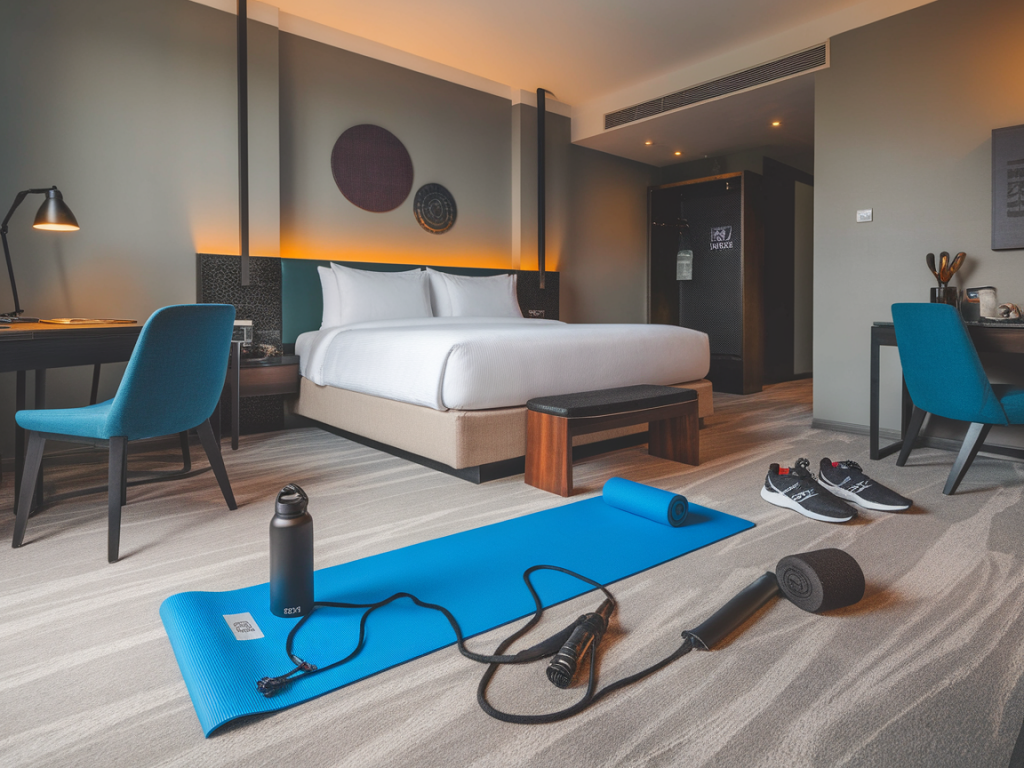
I travel a lot for work and rarely have time to hit a proper gym. Over the years I've learned how to build a 30-minute hotel workout kit that actually replaces a gym session — not perfectly, but well enough that I leave my trips feeling strong, sweaty and energized. Below I share exactly what I pack, why each item matters, and how I use them in short but highly effective sessions. These are the same tools and protocols I rely on when I need a real training stimulus without access to a full facility.
What I pack and why
My kit is designed to be compact, lightweight and versatile. It fits in a carry-on or my backpack and covers strength, conditioning, mobility and core work. Every item earns its place because it lets me scale intensity or replicate common gym moves.
- Light, medium and heavy resistance bands (loop and straight): I bring one lightweight loop band for warm-ups and mobility, a medium loop band for assisted pull-ups and glute work, and a heavy straight band for deadlift/hip-hinge variations and extra resistance on presses.
- Compact suspension trainer or strap trainer (e.g., TRX or similar): Hooks to the door or a sturdy beam — great for rows, single-leg work, push-ups and false-grip progressions. It brings the upper-body pull/push balance back into your routine.
- Adjustable travel dumbbell or a single kettlebell substitute: If I expect a heavier session I pack a foldable adjustable dumbbell or a compact kettlebell like the KettlebellConnect. If I want to stay ultralight, I use a heavy suitcase or filled water bottle for loaded carries and goblet squats.
- Jump rope: Best cardio-to-warm-up ratio. Ten minutes of interval jumping will spike your heart rate quickly and save time compared with trudging on a hotel treadmill.
- Inflatable travel mat or thin yoga mat: For mobility, core work and push-ups. Hotel carpet is fine, but a mat gives comfort and hygiene.
- Small sliders or a towel: For hamstring curls, mountain climbers, and plank variations on carpet or hard floors.
- Bath towel: Useful for resistance band anchors, isometric holds, and as padding for Bulgarian split squats on tile.
- Foam roller or massage ball (mini): For pre/post-workout mobility and recovery.
- Water bottle and scoop of protein: Hydration and post-workout protein help recovery and performance.
My compact packing table
| Item | Weight/Size | Why I bring it |
|---|---|---|
| Resistance bands (3 levels) | ~200–300 g | Replace many machine movements (rows, presses, deadlifts) |
| Suspension trainer | ~350 g | Versatile bodyweight progressions and unilateral work |
| Jump rope | ~100 g | Efficient conditioning |
| Travel mat | ~400–600 g | Comfort for floor work |
| Mini foam roller/massage ball | ~200 g | Tissue prep and recovery |
How a 30-minute session replaces a gym workout
Time is the limiter, not effectiveness. A well-structured 30-minute session hits the same principles as a gym workout: warm-up, compound loading (or scaled substitute), movement variety, conditioning and a mobility/cool-down. Here’s a template I use that consistently produces results.
30-minute hotel full-body workout (no gym required)
- 0–5 min — Warm-up: Jump rope 3 minutes (moderate), banded shoulder circles and band pull-aparts 6–8 reps x 2, bodyweight squats 10 reps.
- 5–16 min — Strength block (EMOM or circuits): Alternate A and B sets for 3 rounds with minimal rest.
- A: Single-arm suspended row 8–10 reps each side + Banded squat (heavy band added) 12 reps
- B: Single-leg RDL using suitcase/kettlebell 8–10 reps each + Incline push-ups with feet elevated on bed 10–12 reps
- 16–24 min — Strength/condition hybrid: 3 rounds for time:
- 12 kettlebell or suitcase goblet squats
- 15 banded hamstring sliders (or sliders with towel)
- 30 seconds max-intensity jump rope
- 24–28 min — Core finisher: AMRAP (as many rounds as possible)
- 10 dead bug toe touches
- 12 side plank taps (6 each side)
- 28–30 min — Brief mobility: 2 minutes of foam-rolling quads/glutes and thoracic rotations with banded stretches
Targeted gym-equivalent substitutions
If you’re worried you’re missing key lifts, here are practical swaps I use to preserve strength adaptations:
- Barbell deadlift → heavy band deadlifts + suitcase single-leg RDL
- Squat rack → band-resisted goblet squats + single-leg pistol progressions
- Lat pulldown → suspension trainer rows and heavy straight-band lat pulls
- Bench press → slow tempo push-ups, band-resisted push-ups, or single-arm pressing using suitcase
Packing and travel tips (practical)
- Roll bands and straps inside shoes or along the edges of your suitcase to save space.
- Check hotel room doors — many door-mounted suspension trainers require the latch style to be safe. If unsure, use the anchor around a heavy fixed object or loop the band through a luggage rack leg.
- If flying, keep bands and rope in cabin luggage. Large kettlebells/dumbbells are usually impractical; opt for suitcase as weight or pre-arrange a dumbbell at a local gym if you need heavy loads.
- Sanitize hotel surfaces before use — a small microfiber towel and spray work wonders.
Common questions I get
“Can these workouts really build strength?” — Yes. Focus on progressive overload with bands (use heavier bands or slower tempos), increase reps, reduce rest, and add unilateral work. Strength gains will be slower than heavy barbell training but still significant, especially when you maintain consistency.
“How do I keep it interesting?” — Rotate emphasis: one trip focus on hypertrophy (higher reps, time under tension), next trip focus on power/conditioning (sprints/jump rope intervals, explosive banded movements). Use the suspension trainer for creative upper-body variations.
“What about recovery?” — Hydrate, prioritize sleep, and use short mobility sessions or the mini foam roller after workouts. A scoop of protein within 60 minutes helps muscle repair, especially after travel days.
Want more workouts like this? I post regular travel-friendly training routines and packing guides at Sport News, where I dive into practical ways to keep performance high on the road.