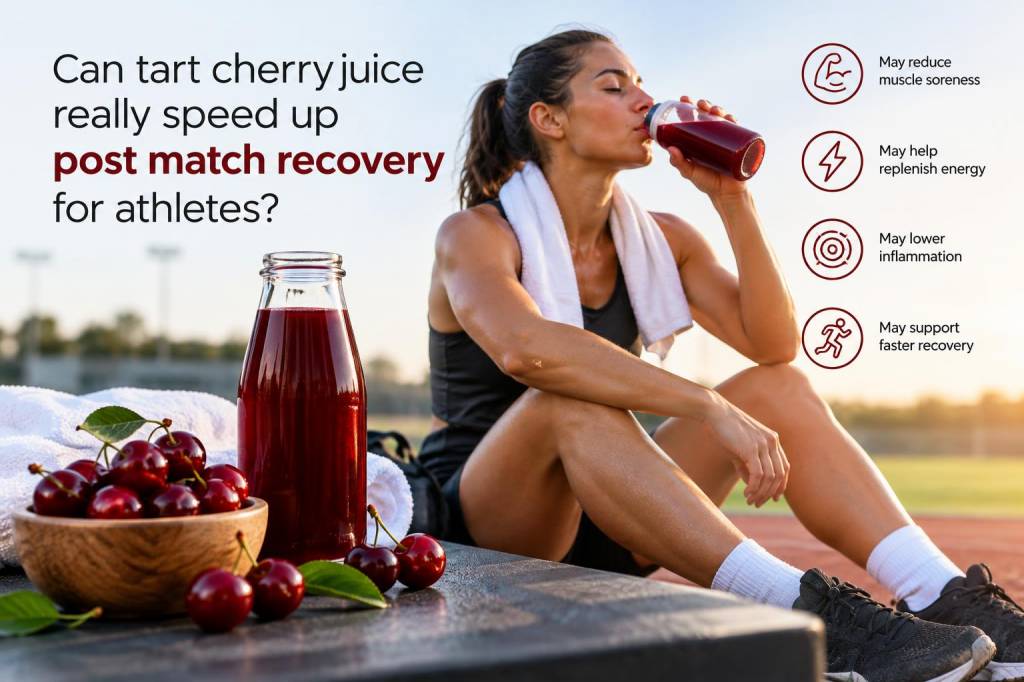
I have spent enough time around training rooms, locker rooms, and post-match routines to know that recovery is where many athletes either gain an edge or quietly lose one. A hard session or a demanding match does not end when the final whistle blows. What happens in the next few hours, and in the next day or two, can shape how you feel, how well you train again, and how ready you are to perform when it matters. That is why tart cherry juice keeps coming up in conversations about sports nutrition. People ask me whether it really speeds up post-match recovery, or whether it is just another trendy drink with a strong reputation and a small effect.
My honest answer is that tart cherry juice can be a useful recovery tool for some athletes, especially when the goal is to reduce soreness, support sleep, and help the body handle the stress of intense exercise. I would not treat it like magic, and I would never say it replaces good sleep, smart training, enough food, or solid hydration. But I have seen enough research and enough real-world use to take it seriously.
What makes tart cherry juice different
Tart cherries are rich in compounds that matter for recovery, especially anthocyanins, which are plant pigments with antioxidant and anti-inflammatory properties. These compounds are one reason tart cherry juice has earned attention in sports nutrition. After a match, the body often deals with muscle damage, oxidative stress, and inflammation. That is a normal response to hard effort, but when it becomes too intense, soreness can linger and performance can suffer.
What interests me most is that tart cherry juice seems to work in a way that is practical, not dramatic. It does not erase the damage from a match. Instead, it may help reduce some of the signals that make muscles feel more beaten up. For athletes who play frequently, that difference can matter a lot.
What I notice when athletes use it
When I talk with athletes who use tart cherry juice consistently, the feedback is usually similar. They do not say they feel invincible. They say they feel a little less stiff, a little less sore, and a little more ready for the next session. That sounds modest, but in sport, modest improvements can be valuable.
I especially think tart cherry juice makes sense in these situations:
That last point matters more than many people realize. Tart cherry juice naturally contains small amounts of melatonin, and some athletes report better sleep quality when they use it in the evening. Since sleep is one of the strongest recovery tools available, anything that supports it deserves attention.
What research seems to suggest
I always prefer a cautious view, because sports nutrition is full of exaggerated promises. Still, tart cherry juice has a decent amount of research behind it. Several studies have found that it may reduce muscle soreness, decrease markers of inflammation, and help athletes recover strength or performance more quickly after strenuous exercise.
From my perspective, the most convincing use case is not a casual weekend workout. It is repeated high-intensity effort. Endurance runners, team sport athletes, and anyone who has to compete again soon after a hard session may benefit more than someone who trains lightly and has several days before the next workout.
I also think it is important to understand that results are not identical for everyone. Some athletes notice a clear difference. Others feel little change. That is normal. Recovery is influenced by training load, sleep, stress, total calorie intake, protein intake, and hydration status. A recovery drink can only work within that bigger picture.
What I would expect from it, and what I would not
I would expect tart cherry juice to be a small but meaningful support for recovery. I would not expect it to cure fatigue, eliminate soreness, or cancel out a poor recovery plan. If an athlete trains too much, sleeps too little, or eats too little, no juice will fix that.
I also think people sometimes misunderstand antioxidants in sport. More is not always better. In very high amounts, antioxidants can interfere with some of the body’s normal training adaptations. That is one reason I like tart cherry juice more as a targeted recovery tool than as a constant daily habit for every athlete year-round. Timing and context matter.
For me, that means using it around especially demanding periods rather than treating it as a permanent requirement. If an athlete is heading into a packed competition schedule, coming off a hard match, or dealing with unusual soreness, that is when I would consider it most useful.
Practical ways I would use it
If I were planning recovery around a match, I would think about tart cherry juice as one piece of the routine, not the entire plan. The exact product can vary, but many athletes use concentrated tart cherry juice, tart cherry shots, or diluted juice. Some products are sweetened, and some are not, so it is worth reading labels carefully.
A simple recovery setup might look like this:
I like that approach because it places tart cherry juice in a real sports nutrition system. It is not just about one ingredient. It is about creating the right environment for the body to repair itself.
Here is a basic comparison I often use when I explain recovery options:
| Recovery Tool | Possible Benefit | My View |
|---|---|---|
| Tart cherry juice | May reduce soreness and support sleep | Useful for intense periods |
| Protein intake | Supports muscle repair | Essential, not optional |
| Carbohydrate intake | Restores glycogen | Very important after matches |
| Hydration | Restores fluid balance | Fundamental for performance |
| Sleep | Drives broad recovery processes | Most powerful tool in the list |
Who may benefit most
I think tart cherry juice is most promising for athletes who face repeated physical stress with limited rest. That includes football players, rugby players, basketball players, runners, cyclists, and many others who train or compete often. It may also appeal to older athletes, who sometimes take longer to bounce back after hard effort.
It can also be useful for athletes who know they are sensitive to post-match soreness and want a nutrition-based way to manage it. If someone is already doing everything else well, tart cherry juice might provide a noticeable extra layer of support.
At the same time, I would be careful with the assumption that it is automatically suitable for everyone. Some athletes have stomach sensitivity, dislike the taste, or simply prefer to focus on whole foods. That is completely fair. A recovery strategy only works if it is realistic and sustainable.
What I look for when choosing a product
If I were selecting a tart cherry product, I would care about a few things. First, I would want a clear amount of tart cherry content, because product strength can vary a lot. Second, I would check sugar content, especially if I planned to use it frequently. Third, I would look for a product that fits the athlete’s routine and budget, because consistency matters more than marketing.
I would also pay attention to timing. Some athletes take it for several days before and after competition, while others use it only after especially hard matches. There is no single perfect method for everyone, and I would rather test a routine in training than experiment during an important event.
My personal view on whether it really works
If you ask me whether tart cherry juice really speeds up post-match recovery, I would say yes, it can help, but in a limited and specific way. I do not see it as a miracle drink. I see it as a sensible recovery support that may reduce soreness, help the body handle training stress, and improve sleep in some athletes. That combination can matter more than people expect.
What I like most is that the evidence and the experience line up reasonably well. The science suggests a benefit, and many athletes report a practical difference. That does not mean it works identically for everyone, and it does not replace the basics. But in a sport environment where recovery time is precious, a small edge can be valuable.
If I were advising an athlete after a demanding match, I would say this: focus first on sleep, fluids, protein, and carbohydrates. Then consider tart cherry juice as an added recovery tool, especially when matches come thick and fast. That is where it earns its place in a serious nutrition plan.