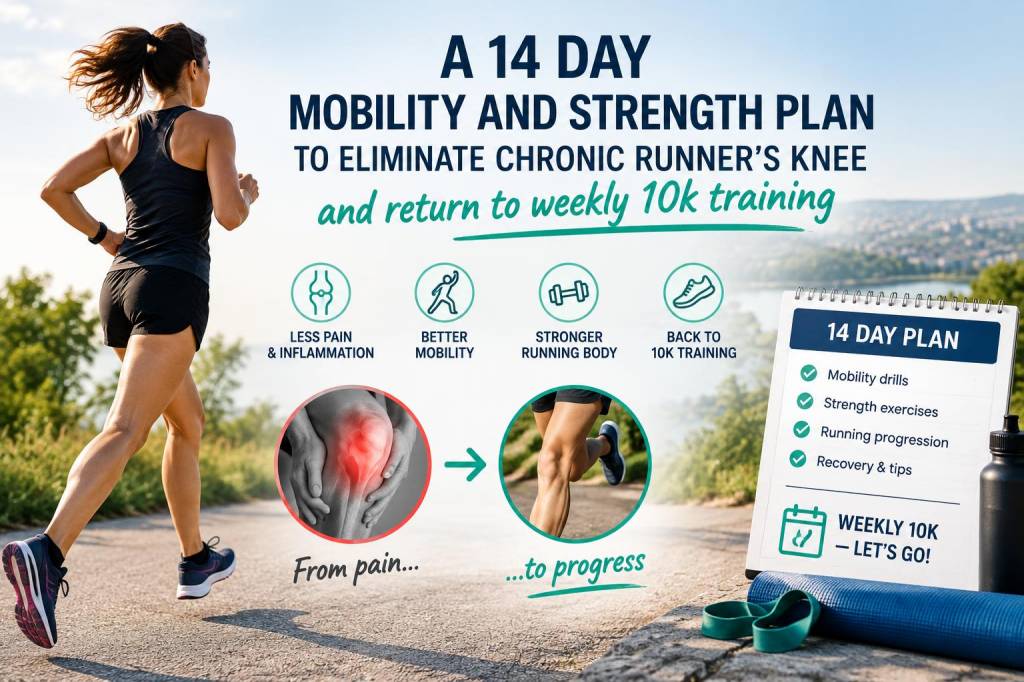
I used to push through every niggle, convincing myself that pain was just part of being a committed runner. That changed when a persistent ache under my kneecap—classic runner's knee (patellofemoral pain)—stopped me from doing my regular 10k and made stairs feel like torture. Over the years I’ve trialed dozens of mobility drills, strengthening protocols and recovery tools. What follows is a focused 14-day mobility and strength plan I put together from what actually worked for me and many runners I coach. It’s designed to reduce pain, restore movement patterns and get you back to weekly 10k training safely.
Why 14 days?
Two weeks is long enough to break movement patterns, reduce inflammation with consistent habits, and build initial strength and motor control. It’s short enough to stay motivated and integrate into a training calendar. This plan is not a cure-all for every case of runner's knee—if your pain is severe or accompanied by swelling, locking, or instability, see a healthcare professional first. But for overuse-related patellofemoral pain, this approach can rapidly improve symptoms and confidence.
Principles behind the plan
- Reduce aggravation: Avoid activities that flare the pain (e.g., deep squats, repeated downhill running) until you’ve cleared a few pain-free sessions.
- Improve mobility: Restore ankle, hip and knee range of motion so movement is balanced.
- Build strength: Target glute medius, glute max, quadriceps (especially vastus medialis oblique), and hip external rotators.
- Movement quality: Re-teach proper knee tracking and single-leg control with low-load, high-quality reps.
- Progressive load: Gradually reintroduce running volume with pain monitoring—no more than a 10% increase per week when fully back.
Tools I recommend
- Foam roller or massage ball (TriggerPoint or a lacrosse ball)
- Theragun or percussive massage tool (optional but accelerates recovery)
- Light resistance bands (mini loop and long band)
- Adjustable dumbbells or kettlebell (4–12 kg depending on strength)
- Stable step or low box for step-ups
How to use pain as a guide
A useful rule: you should feel mild discomfort during exercises, but pain should not increase the next day. If an exercise creates sharp pain or swelling, stop and modify. Keep a simple daily log: pre-exercise pain (0–10), post-exercise pain, next-morning pain. If next-morning pain is worse, reduce intensity.
Daily routine structure
Each day in the plan follows this template:
- Warm-up (5–8 minutes): light cardio or dynamic mobility
- Mobility and soft-tissue work (10–12 minutes)
- Strength and motor-control session (15–25 minutes)
- Optional gentle cardio (10–20 minutes walk or easy bike)
Key exercises explained
- Clamshells with band: Lying on side, knees bent, band above knees. 2–3 sets of 15 controlled reps. Targets glute medius.
- Single-leg Romanian deadlift (RDL): Hinge at hips, maintain slight knee bend, use bodyweight or light dumbbell. 3 sets of 8–10 per side for control and posterior chain strength.
- Isometric wall sit with emphasis on VMO: 30–60 seconds with slight toe-out and focus on quad contraction near the top range.
- Terminal knee extensions (TKE) with band: Attach band behind knee, bend slightly and extend knee resisting the band. 3 sets of 15.
- Quadriceps eccentrics (slow decline step down): 3 sets of 8 controlled negatives per leg.
- Hip bridge with band: Band above knees, squeeze glutes at top. 3 sets of 15.
- Foam rolling & ball release: Quads, IT band (avoid direct pressure on the knee), glutes. 1–2 minutes per area.
14-day schedule
| Day | Focus | Session |
|---|---|---|
| Day 1 | Assessment & gentle mobility | Warm-up 5 min walk → Foam roll quads/glutes (5-8 min) → Clamshells 3x15 → Glute bridge 3x15 → 10 min easy bike |
| Day 2 | Strength & single-leg control | Dynamic warm-up → TKE 3x15 both → Single-leg RDL 3x8 each → Step-up 3x10 each → 10–15 min walk |
| Day 3 | Mobility & recovery | Foam roll 8–10 min → Hip opener stretches (pigeon, 90/90) 10 min → Isometric wall sit 3x30–60s → Gentle bike 15 min |
| Day 4 | Strength progression | Warm-up → Banded lateral walks 3x20 steps → Bulgarian split squat (bodyweight) 3x8 each → Clamshells 3x20 → 10 min walk |
| Day 5 | Neuromuscular & plyo prep | Warm-up → Short bounds (low intensity) 6x20m → Controlled decline step-downs 3x8 each → Hip bridges 3x20 |
| Day 6 | Active recovery | Yoga-focused mobility 20–25 min (emphasis hips/hamstrings) → Foam roll 5–8 min |
| Day 7 | Test run (short) | 10–15 min easy run or run/walk. Keep effort very easy; stop if pain >3/10. Follow with foam rolling and TKEs. |
| Day 8 | Load adjustment & strength | If Day 7 was pain-free: single-leg RDL 3x10, step-ups 3x12. If painful: repeat Day 4 session and rest run. |
| Day 9 | Mobility & isometrics | Foam roll 8–10 min → Isometric wall sits 4x30–60s → Banded clams 3x20 → Gentle bike 15 min |
| Day 10 | Strength + short run | Warm-up → TKE 3x15 → Bulgarian split 3x10 → 15–20 min easy run (or run/walk) if pain <=2/10 |
| Day 11 | Speed control & motor patterns | Warm-up → Low-intensity strides 6x60m focusing on form → Single-leg balance work 3x30s each → Foam roll |
| Day 12 | Load tolerance check | 20–25 min easy run maintaining pain <=2/10 → Post-run TKEs and hip bridges → Recovery mobility |
| Day 13 | Final strength push | Warm-up → Single-leg RDL 3x10 → Step-ups weighted if pain-free 3x10 → Clamshells 3x20 → Light mobility |
| Day 14 | Return-to-10k prep run | 30–40 min easy run (target 5–8k at easy pace). If pain remains <=2/10 and controlled next day, you can plan a 10k training run next week with gradual increase. |
Progression into weekly 10k training
Assuming Day 14 run is comfortable, reintroduce full 10k sessions gradually over 3–4 weeks. Example weekly progression:
- Week 1 post-plan: two easy runs (30–40 min) + one long run 60–75% of your usual 10k distance.
- Week 2: increase long run to 80–90% of usual 10k, add one session with short pickups but no hard intervals.
- Week 3: resume regular weekly 10k run if pain remains minimal; keep one strength maintenance session (20–25 min) twice a week.
Maintenance and tips I swear by
- Keep performing glute activation and TKEs twice weekly as ongoing injury prevention.
- Use a foam roller or massage ball daily for 5–10 minutes on tight quads and glutes—Pipeline of relief includes Theragun or a hand-held percussive tool on low settings for 1–2 minutes per muscle group.
- Replace worn-out shoes and consider a gait assessment if knee pain recurs.
- Focus on sleep, anti-inflammatory nutrition (omega-3s, colorful vegetables), and maintaining a healthy training load.
Stick with the plan, be patient with load increases, and listen to your body. This 14-day protocol isn’t magic, but it is a concentrated, evidence-informed path back to pain-free running and consistent 10k training.