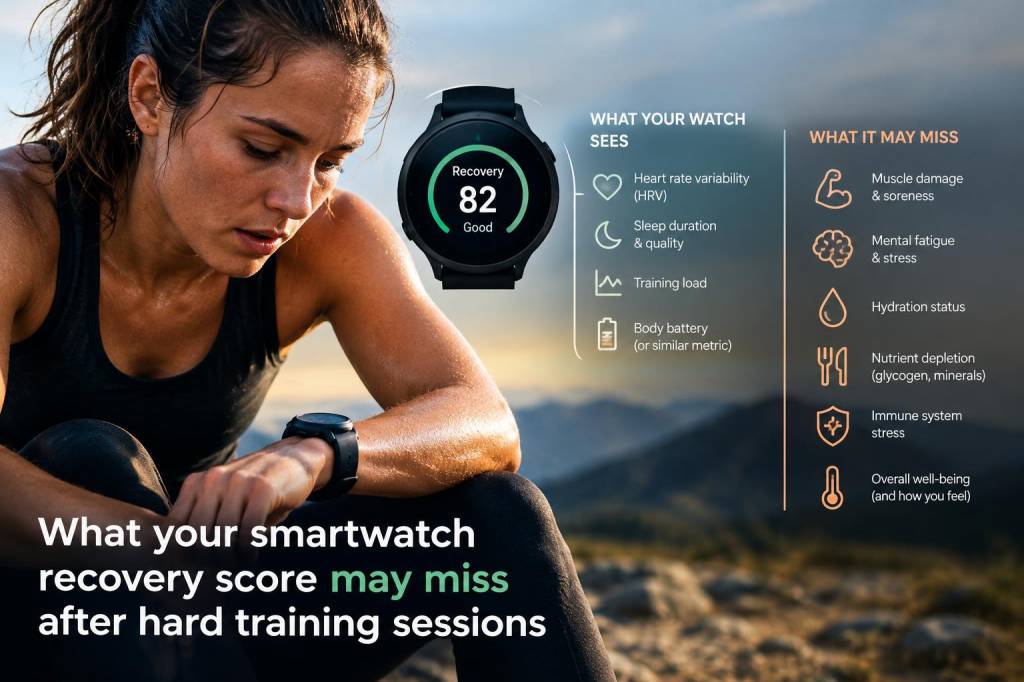
After a hard training session, I like seeing a smartwatch recovery score as much as anyone else. It feels tidy, precise, and reassuring: one number that seems to tell me whether I am ready to train again or whether I should back off. But over time, I have learned that a recovery score is only a snapshot. It can be useful, yet it can also miss some of the most important signs of how my body and mind are actually coping.
That gap matters more than people think. I have had days when my watch told me I was nearly fully recovered, yet my legs felt heavy from the first warm-up rep. I have also had sessions where the score looked mediocre, but I felt mentally sharp, physically fine, and ready to perform. The more I train, the more I understand that recovery is not a single feeling and definitely not a single metric. It is a mix of muscle repair, nervous system fatigue, sleep quality, stress, hydration, glycogen, motivation, and even how much emotional load I am carrying.
Why a recovery score can feel more confident than it should
Most smartwatch recovery scores are built from a limited set of inputs. Depending on the device, that may include heart rate variability, resting heart rate, sleep duration, sleep stages, recent training load, and sometimes breathing rate or stress estimates. I do not dismiss any of those numbers. In fact, I pay attention to them. But I also know they are proxies, not direct measurements of readiness.
What I have noticed is that a score can look clean while missing context. For example, if I sleep eight hours but wake up several times because of dehydration, late eating, or mental stress, my watch may still give me a decent rating. If I finish a brutal interval session and my heart rate settles quickly, the device may think I am fine, even though my quadriceps are still full of damage from eccentric work. That is not a flaw in the device alone. It is simply a reminder that recovery is broader than what sensors can fully capture.
I also think many athletes overtrust the number because it is easy to understand. A green score feels like permission. A red score feels like a warning. But training is rarely that neat. Some sessions are worth doing even when I am not fully fresh, and some easy sessions still need adjustment even when my score looks excellent. The number should inform my decision, not replace it.
What my smartwatch may miss after very hard sessions
One of the biggest blind spots is local muscle damage. After sprint repeats, heavy squats, downhill running, or long tempo intervals, I can have significant fatigue in a specific muscle group even if my overall cardiovascular markers look normal. A smartwatch can estimate systemic strain, but it cannot directly feel the tiny tears, stiffness, and soreness inside my muscles. If I rely on the score alone, I may underestimate how much my legs need recovery.
Another thing it can miss is central fatigue. After a very hard session, my nervous system sometimes feels flat. My body can move, but my drive is lower, my coordination is slightly off, and I do not have the same snap in my first steps or lifts. That kind of fatigue is subtle. It does not always show up clearly in overnight metrics, especially if I slept reasonably well.
Then there is fuel status. I have seen my recovery score look strong after a session when I was actually under-fueled. If glycogen is low, I may still appear “recovered” from a heart-rate perspective, but my next workout can feel sluggish. My legs do not lie, even when the app does not notice. If I do not restore energy intake after a demanding effort, the score may improve faster than my performance does.
Hydration is another gap. A watch might detect elevated heart rate variability or resting pulse changes, but it cannot fully know whether I lost too much fluid or sodium during a sweaty session. Dehydration can make me feel tired, cranky, and less powerful, even if the algorithm thinks I am ready. This is especially true in hot weather or during indoor sessions with poor airflow.
Sleep quality is also more complex than a simple duration number. I have had nights where my watch reported enough total sleep, yet I slept lightly, dreamed intensely, and woke up feeling unrefreshed. Stress, late caffeine, late meals, travel, and screen exposure can all make sleep less restorative without necessarily destroying the final score. On paper, I may look okay. In practice, I feel dull.
Finally, a smartwatch often misses psychological readiness. Motivation is not everything, but it matters. When I feel mentally stressed, distracted, or emotionally drained, I do not process hard training in the same way. My tolerance for discomfort changes, and so does my concentration. A recovery score cannot fully capture whether I am ready to face another demanding block, race, or heavy lift with the right mindset.
Signs I trust more than one number
When I want a clearer picture, I look at several simple signs together. None of them is perfect on its own, but together they tell me much more than a recovery score alone.
- Morning body feel: I notice how stiff, loose, or heavy my legs feel when I get out of bed.
- Warm-up response: I pay attention to whether my heart rate climbs unusually fast and whether my movement feels fluid.
- Breathing comfort: Easy breathing during low-intensity work often tells me more than a score does.
- Grip and coordination: If my movements feel clumsy, I take that seriously.
- Hunger and thirst: Strong hunger or thirst can point to incomplete recovery or poor fueling.
- Mood and focus: If I feel flat, irritable, or mentally foggy, I reduce expectations.
I have also learned to watch my performance in small ways. If my usual easy pace feels hard, if my bar speed drops in the gym, or if I need much more effort for the same output, that is useful information. Those are real-world signals. They reflect how recovered I actually am, not just how the algorithm interprets the data.
Why hard sessions can distort recovery data
Very intense training can confuse wearable metrics for a while. Right after a demanding session, my heart rate may remain elevated, then settle quickly. My smartwatch may interpret that fast drop as a positive sign. But if the session created large muscle damage or significant energy depletion, the device may not immediately understand the full cost. That is one reason I avoid making same-day decisions based only on a score.
I have also noticed that repeated hard sessions can create adaptation in the data itself. Over time, my body may respond differently to the same workload. A workout that once crushed me may later look less dramatic on the watch because my resting pulse has improved or my HRV trend has stabilized. That can be encouraging, but it can also hide accumulated fatigue. Fitness gains can make the numbers look better while the deeper cost is still building.
Travel makes things even messier. If I train after a short flight, poor meals, changed time zones, or a long day on my feet, my score may not fully reflect the strain. A wearable sees physiology, but not life circumstances. Yet life circumstances often shape recovery as much as the workout itself.
What I do instead of trusting only the score
I like using my smartwatch as one piece of evidence. I check it, but I do not obey it blindly. When the score is low, I ask why. Was my sleep poor? Did I train especially hard? Am I stressed? Am I underfed? If I cannot identify a reason, I treat the number cautiously. When the score is high, I still ask whether my body actually feels ready.
I also adjust training with a little flexibility. If I planned a heavy day but my body feels off, I may reduce volume, lower intensity, or focus on technique. If I planned an easy day but my score looks poor and my warm-up feels rough, I may keep the session truly easy instead of forcing the plan. I have found that this approach protects consistency better than stubbornness does.
For me, a practical recovery check often includes:
- What did I train yesterday?
- How did I sleep, really?
- Did I eat enough after training?
- Do I feel soreness in one specific area or fatigue everywhere?
- Does my warm-up improve my sensations or reveal more problems?
- Am I mentally ready to push, or am I just trying to follow the plan out of habit?
That last question matters more than many people admit. Sometimes I want the watch to make the decision for me because it is easier. But training progress usually comes from better judgment, not easier judgment. The score can support that process, yet it cannot replace self-awareness.
How I read recovery trends instead of single readings
I get more value from patterns than from isolated numbers. One low score is not very meaningful if it follows a brutally hard workout. Three low scores in a row, combined with poor sleep and declining performance, tell a much stronger story. Likewise, one high score after an easy day does not mean I am fully ready for another major stressor.
That trend-based thinking helps me avoid overreacting. It also keeps me honest. If my scores look decent but my sessions keep feeling worse, I know something else is going on. Maybe I need more carbohydrates, more sleep, less life stress, or a deload week. Maybe I simply need to stop using the watch as a shield against common sense.
In the end, I want a recovery score to behave like a useful assistant, not a judge. It should point me toward questions, not answer everything for me. The best training decisions I make come when data, sensation, and context all agree. When they do not, I usually trust the lived experience in my body first, then use the numbers to refine the picture.
| What a smartwatch often sees | What it may miss | What I check myself |
|---|---|---|
| Heart rate trends | Local muscle damage | Leg soreness, stiffness, movement quality |
| HRV changes | Psychological fatigue | Motivation, focus, mood |
| Sleep duration | Sleep depth and disruption | Morning freshness, mental clarity |
| Training load | Fuel depletion | Energy levels, hunger, workout feel |
When I think about recovery honestly, I see it as a conversation between data and experience. My smartwatch can start that conversation, but it cannot finish it for me.