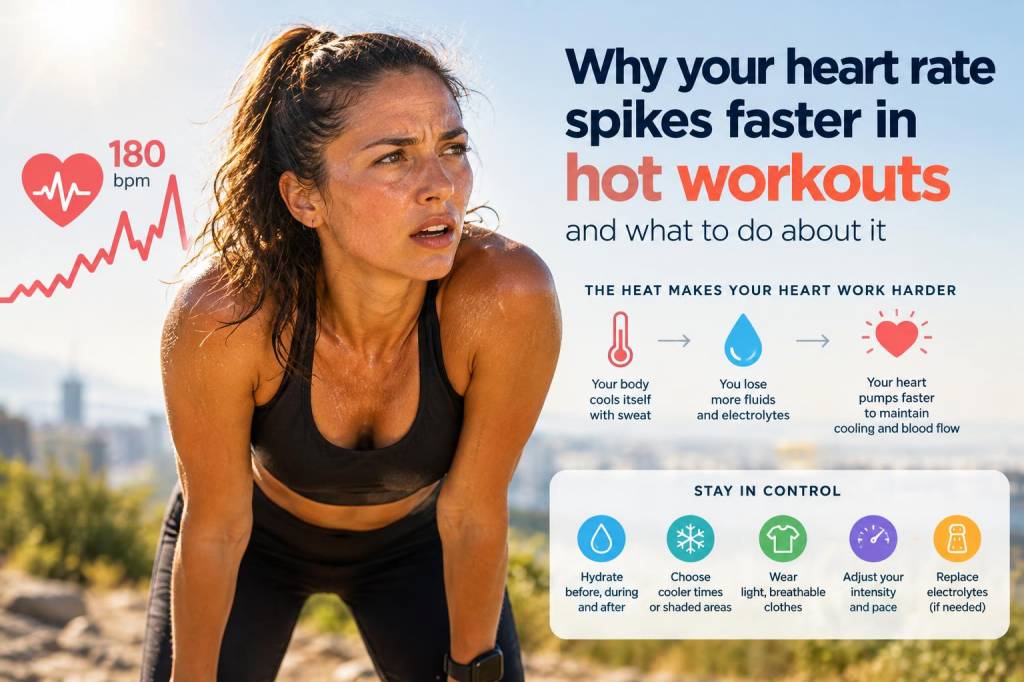
I have noticed a pattern in my own workouts that used to catch me off guard: when the room gets hot, my heart rate climbs faster than I expect, even when the pace feels familiar. A run that usually feels steady suddenly feels tougher. A strength circuit that I can normally finish with control starts pushing me into a higher effort zone. If you have ever looked at your watch and wondered why your heart is racing so much sooner in a hot session, you are not imagining it.
Heat changes the way your body works. During exercise, your muscles produce heat, and your body has to move blood in two directions at once: toward working muscles and toward the skin so you can cool down. That means your heart has to work harder to keep everything going. I think this is one of the most useful things to understand about training in heat, because once you know what is happening, the numbers on your monitor stop feeling mysterious.
What heat does to your body during exercise
When I train in a warm environment, my body sends more blood to the skin to release heat. At the same time, my muscles still need oxygen and nutrients. This creates a kind of internal competition for blood flow. To keep up, my heart rate rises. Even if I am not moving much faster, my cardiovascular system has to do more work to maintain the same output.
Another factor is sweat loss. As I lose fluid, blood volume can drop slightly. With less fluid in circulation, the heart may beat faster to maintain blood pressure and circulation. That is one reason a workout can feel progressively harder as it goes on in hot conditions. The effort is not only about fitness level. It is also about temperature, humidity, hydration, and duration.
I also think humidity deserves more attention than it gets. In dry heat, sweat can evaporate more easily, which helps cool the body. In humid air, sweat lingers on the skin and does not cool as efficiently. That means the body has to rely even more on circulation, and heart rate can rise sooner.
Why the same workout feels different in heat
One of the most frustrating things for athletes and fitness fans is that a pace or load that feels manageable in cool conditions can feel punishing in heat. I have had days when I felt strong during warm-up, then watched my heart rate jump far above normal once I started the main set. That does not automatically mean something is wrong. It often means the body is adapting to a tougher environment.
Here are a few reasons the same workout feels harder:
- Higher core temperature forces the body to prioritize cooling.
- Dehydration reduces circulating fluid and increases strain on the heart.
- Humidity limits sweat evaporation and makes cooling less efficient.
- Accumulated fatigue from earlier sessions can make heat feel more intense.
- Poor sleep or low fuel intake can make heat tolerance worse.
What surprises many people is that this response can happen even in fit, experienced athletes. A strong heart does not make heat disappear. It just helps the body cope better, and even then there are limits.
What I watch for in my own training
I like using heart rate as a clue rather than a verdict. If my heart rate rises faster than usual, I ask a few simple questions. Am I hotter than normal? Have I drunk enough water? Did I eat enough before training? Am I under-recovered from a harder day? Those answers usually explain more than the number alone.
I also pay attention to effort perception. If a moderate run suddenly feels like threshold work, I know I need to adjust. Heat can distort pacing, so I rely less on ego and more on body feedback. On especially hot days, I will often slow down early instead of waiting until I am already overcooked.
Breathing is another clue. If I am breathing harder than expected at an easy pace, I treat that as a signal to back off. Heat stress can build quietly before it becomes obvious, so I prefer to respond early.
What to do before a hot workout
Preparation makes a huge difference. I have learned that a hot session goes better when I set myself up before I even start. The goal is not to eliminate the heat. It is to reduce the stress it creates.
- Hydrate before exercise so you begin in a better fluid state.
- Eat enough earlier in the day so your body is not handling heat and low fuel at the same time.
- Choose lighter clothing that allows sweat to evaporate.
- Warm up gradually instead of starting hard right away.
- Train at cooler hours when possible, especially for long or intense sessions.
I also like to think about expectations. If I know it is going to be hot, I plan a slightly easier effort target. That small adjustment helps me avoid frustration and prevents me from turning a normal workout into a survival test.
What to do during exercise
Once I am in the workout, my main job is to stay responsive. I do not wait until I feel terrible. I make small adjustments as soon as the session starts to drift out of control. Sometimes that means slowing pace. Sometimes it means adding a short walk break. Sometimes it means reducing load or shortening intervals.
Cooling strategies can help more than people expect. A fan, a shaded route, cold water, or even splashing water on the face and neck can reduce thermal strain. In my experience, small cooling actions can lower the sense of effort enough to let me keep training safely.
For longer sessions, I pay attention to sweat loss. If I am sweating heavily, I may need water plus electrolytes, especially in prolonged or repeated sessions. I do not treat every workout the same way, because not every workout creates the same fluid demand.
| Situation | What I notice | What I do |
|---|---|---|
| Warm room, short session | Heart rate rises early but stays manageable | Slow the first minutes and keep a steady pace |
| Hot and humid outdoor run | Pace feels harder than usual | Reduce speed, choose shade, drink before and after |
| Long circuit workout | Heart rate stays high between sets | Extend rest, lower load, use a fan if available |
| Spinning or treadmill class | Sudden spike in effort and breathing | Back off resistance or incline, then rebuild gradually |
What heat adaptation really looks like
The good news is that the body can adapt to heat over time. With repeated exposure, many people notice lower heart rate at the same workload, improved sweating efficiency, and less overall strain. I have felt this myself after a stretch of warmer-weather training. The first few sessions can feel rough, but after a period of consistent exposure, the same conditions become easier to handle.
That said, adaptation is not instant. It develops gradually, and I do not try to force it with reckless workouts. I prefer controlled exposure: manageable sessions, careful hydration, and smart intensity. That approach gives the body a chance to adapt without pushing into unnecessary risk.
Heat training can be useful for endurance athletes, but it is not something I would recommend approaching casually. The point is to build tolerance, not to prove toughness. If a session starts to feel unsafe, I stop treating it as a conditioning challenge and start treating it as a recovery issue.
When a high heart rate is a warning sign
A rising heart rate in heat is normal, but there is a difference between normal strain and a warning sign. I take symptoms seriously if they go beyond ordinary effort. Dizziness, nausea, confusion, chills, headache, loss of coordination, or a sudden inability to keep going are all signs that the body may be struggling with heat stress.
If I feel unusually weak or my heart rate stays high even after I slow down, I do not try to power through. I get to a cooler place, hydrate, and stop the workout. For anyone with a history of heart conditions, fainting, or heat illness, it is especially important to speak with a medical professional before pushing through hot training conditions.
What I keep in mind for different workout types
Not all training responds to heat in the same way. A steady run, a HIIT session, and a yoga class may all trigger different heart rate responses. For me, interval work in heat feels especially intense because the spikes come fast and the recovery time feels shorter. Endurance sessions can be sneaky because the strain builds slowly.
Strength training in heat can also surprise people. Even if the heart rate does not stay elevated as long as in cardio work, the combination of heat, rest intervals, and muscular effort can make sets feel heavier. I pay attention to whether I am losing precision in movement. If form starts slipping, that is a sign I am not managing heat well.
In classes, I like to choose positions near ventilation or open space when possible. That small choice can make a real difference, especially during repeated rounds or long flow sessions.
If I had to sum up my own experience in one sentence, it would be this: heat does not just make workouts feel harder, it changes the entire balance of effort, cooling, and recovery. Once I started respecting that, I stopped treating a faster heart rate as a failure and started using it as useful information.